
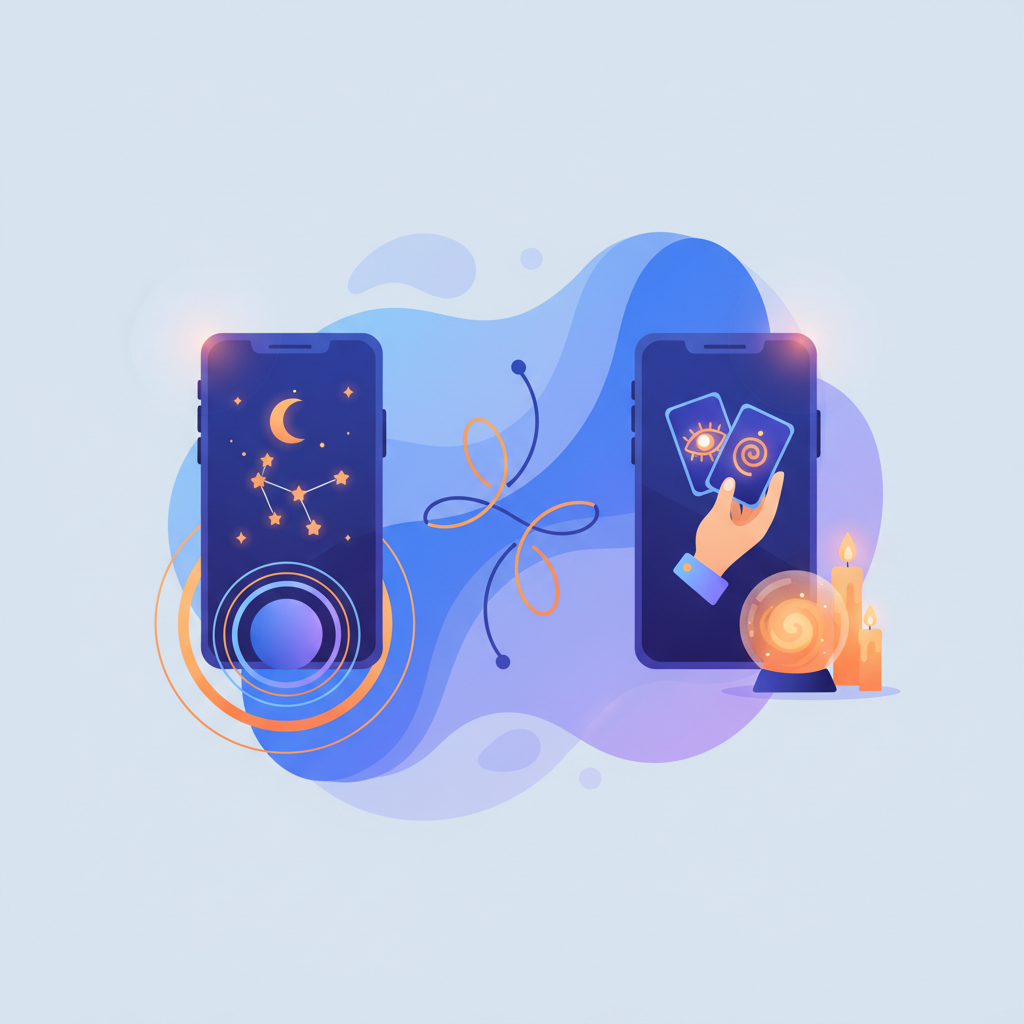
If you’ve browsed the App Store for spiritual guidance, you’ve probably noticed two main categories: astrology apps and psychic reading apps. While they overlap in some areas, they serve fundamentally different purposes.
Astrology Apps: Data-Driven Cosmic Insight
Astrology apps like Co-Star, The Pattern, and TimePassages focus on your birth chart — the precise positions of planets at the moment you were born. They generate automated daily horoscopes, compatibility reports, and transit forecasts based on astronomical data.
Strengths
- Free or inexpensive
- Available 24/7 without waiting for a human reader
- Consistent and data-based
- Great for daily check-ins and general guidance
Limitations
- Generic — same horoscope for everyone with your sign
- Can’t answer specific personal questions
- No human intuition or empathic connection
- Unable to pick up on unique energy or circumstances
Psychic Reading Apps: Human Intuition Meets Technology
Psychic apps like those reviewed on Top Psychic Apps connect you with live human advisors who use their intuitive gifts — often combined with tools like tarot, astrology charts, or mediumship — to provide personalized guidance.
Strengths
- Personalized to your specific situation
- Can address any question or concern
- Human empathy and emotional support
- Combines multiple modalities (tarot + astrology + intuition)
Which Should You Choose?
Use astrology apps for daily cosmic weather and general awareness. Use psychic reading apps when you need personalized guidance on a specific situation. Many people use both — checking their horoscope each morning and consulting a psychic advisor for major life decisions.
Two Different Categories With Different Strengths
Astrology apps and psychic reading apps share a category but operate quite differently. Astrology apps work primarily through structured calculation – your birth chart, transits, progressions, and synastry are derived deterministically from astronomical data. The interpretation is human-written or AI-generated, but the underlying inputs are math. Psychic reading apps work through human practitioners who tune in live to your energy. The inputs are intuitive rather than calculated, and they vary session to session.
Where Each Mode Excels
- Astrology apps excel at: long-term timing, structural understanding of personality, mapping cycles in your life, comparing two charts, providing a stable reference you can revisit over years.
- Psychic reading apps excel at: sensing the current energy of a specific situation, picking up on a person’s feelings, getting an outside view at a crossroads, mediumship, sessions that benefit from real-time human responsiveness.
Combining Both Wisely
Many people find that astrology apps and psychic reading apps work well together. The astrology app provides the long-range frame – the year ahead, the major cycles, the structural background. The psychic app provides the close-up reading on a specific moment within that frame. Used this way, the two formats are complementary rather than competing.
Choosing Your Default
If you’re newer to the spiritual self-knowledge space, an astrology app is usually the gentler starting point. The information is structured, you can revisit it at your own pace, and there’s no per-minute clock running. Psychic reading apps tend to be more rewarding once you’ve already developed a sense of what you’re looking for – they give you the sharpest answers to specific questions, but the format demands more from you in terms of asking well.
One Last Pattern Worth Naming
The clients who consistently get the most value from psychic reading apps over years tend to share three habits. They’re patient about finding readers they trust, sampling with short sessions before committing. They return to those trusted readers regularly rather than constantly switching. And they treat the readings as inputs to their own decision-making, not as decisions delivered from outside. None of these habits is surprising on its own; together, they’re what separates the people who keep finding the apps useful from the people who give up after a few uneven sessions. The structure of the apps rewards discernment – clients who develop it tend to do well, and the rest tends to follow.